Discounts Are Destroying Your Reputation. Here’s Why.


Discounts feel like the fastest way to fill the schedule, but the cycle they create quietly destroys your reputation and hurts the business.
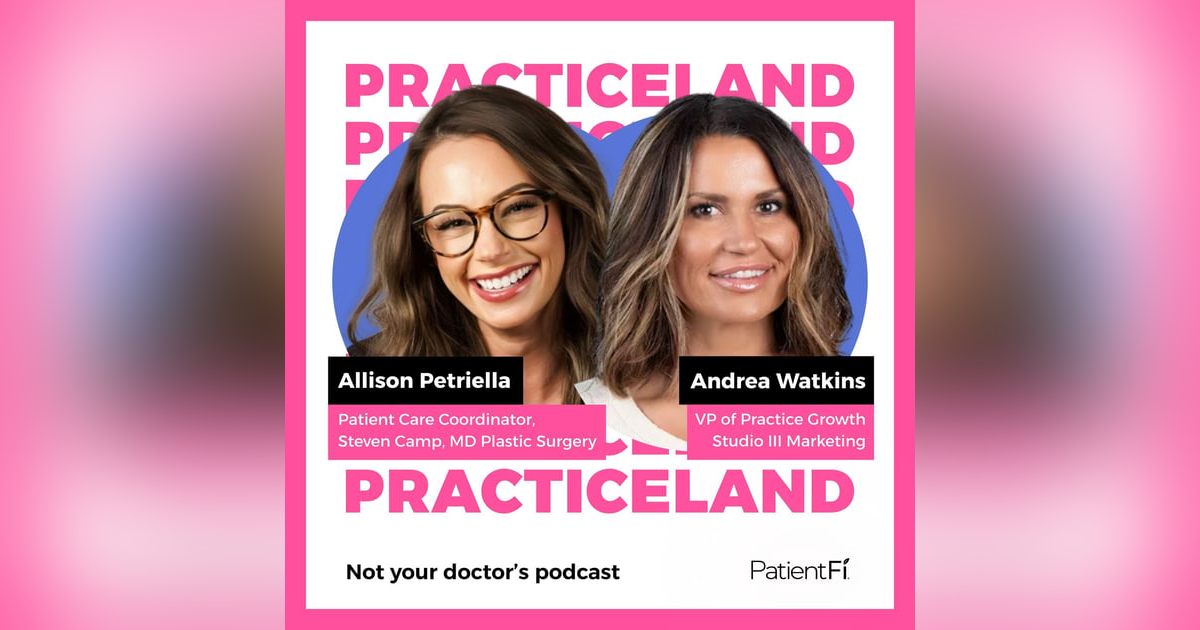
Tackling one of the most controversial topics in aesthetics, Andrea and Alli argue against making deals to book patients — because the consequences attract the wrong clientele, degrade your value, and turn surgery into a negotiation rather than a life-changing experience.
Find out how high-performing practices avoid discounts entirely, why confident pricing actually improves patient quality and conversion rates, and the one rare exception where a small incentive makes sense — and how to use it without undermining everything else.
GUEST
Allison Petriella
Patient Care Coordinator at Steven Camp, MD Plastic Surgery and Aesthetics
Alli is a results-driven sales professional and consultant with 12+ years of experience helping healthcare and aesthetics practices grow through technology, strategy, and process optimization. She specializes in guiding practices to overcome operational challenges and maximize growth by leveraging cutting-edge software solutions and streamlining patient care. Alli recently moved back inside of the practice as a Patient Care Coordinator to partner with patients on their surgical journey and restructure the patient intake process.
Connect with Alli on LinkedIn
SHE DID WHAT?
Got a wild customer service story or a sticky patient situation to share? If your tale makes it into our "She did what?" segment, we'll send a thank you gift you'll actually love. Promise, no cheap swag here. Send us a message or voicemail at practicelandpodcast.com.
SUBSCRIBE
Are you one of us? Subscribe for new episode notifications and more at practicelandpodcast.com.
HOSTS
Blake Lucas, Senior Director of Customer Experience at PatientFi
Blake oversees a dedicated team responsible for managing patient and provider inquiries, troubleshooting technical issues, and handling any unexpected challenges that come their way. With a strong focus on delivering exceptional service, he ensures that both patients and providers receive the support they need for a seamless experience.
Learn more about PatientFi
Andrea Watkins, VP of Practice Growth at Studio III Marketing
Andrea Watkins, Vice President of Practice Growth at Studio 3, coaches plastic surgery and aesthetics teams on patient acquisition, lead management, and practice efficiency to drive measurable growth. Formerly COO of a multi-million-dollar practice that nearly tripled revenue under her leadership, she now partners with over 100 practices nationwide—helping them capture and analyze data, streamline consultations and booking, and align staff training with business goals. With a directive yet approachable, non-salesy style, Andrea turns data into action, empowering practices to boost conversions, maximize marketing, and elevate the patient experience in a competitive market.
Learn more about Studio III Marketing and LeadLoop CRM for plastic surgery practices and medical spas.
Co-hosts: Andrea Watkins & Blake Lucas
Producer: Eva Sheie @ The Axis
Assistant Producers: Mary Ellen Clarkson & Hannah Burkhart
Engineering: Cameron Laird
Theme music: Full Time Job, Mindme
Cover Art: Dan Childs
Practiceland is a production of The Axis: theaxis.io
Andrea (00:04):
Well, hi there. I am Andrea Watkins, and if you're listening to this while juggling three patient calls, checking in a couple patients, taking a payment, selling skincare, and trying to catch your doctor in between procedures, you might be working in an aesthetic practice.
Blake (00:18):
And I'm Blake Lucas, and this is PracticeLand. This is not your doctor's podcast.
Andrea (00:26):
Welcome back to PracticeLand, where we help you learn and earn. We are back again with Alli Petriella. So today we're really going to focus on this topic of discounts. And debate, although it's not really a debate because Alli and I are on the same page of this, when, if ever, is it a good idea to use discounts? And Alli, thank you again so much for joining us to talk about this really hot topic.
Alli (00:56):
Yeah. I'm so excited to be here and to chat about this. I think this is a good one.
Andrea (01:00):
Yes. Very good. So I'm going to paint a picture here. The consultation is done. They've left the building. You're onto the next consultation. They've left the building. And at the end of the day, you're a doctor. You do your debrief and you say, "Here's the consults we saw. This is how the result was. " Either they scheduled their procedure, maybe they didn't schedule their procedure. And the surgeon says, "Well, that one that didn't call, call or offer a discount." Have you ever heard that before? Does that sound familiar? Do you know of practices that have this sort of strategy?
Alli (01:36):
I have heard that. And I've actually been asked myself to do that and I do not think that there's really a time and a place where that's appropriate. It kind of seems like we really need them to book and that's not what it's about. It's about connecting patients with the journey that's right for them. So I don't want it to be like, "Oh, hey, we just really want to capitalize on this opportunity, so what do we need to do to earn your business?" That's kind of how that sounds to me. And that's not what's going to get the job done. We need to stand on business and this is the value of the service that we are providing and this is how much it's worth and we're not coming back on that.
Andrea (02:19):
So let's just kind of start with why do you think this keeps happening with doctors or maybe even with PCCs themselves where we're just feeling like, "Oh, we have to do whatever we have to do to get someone to schedule their procedure." Where do you think that comes from?
Alli (02:37):
I think part of it might be pressure of a high conversion rate and wanting to make sure that we're not wasting our time with consultations. And then some of it's like lack of confidence in our price point or the value that we're providing. When you know that the level of service that you're providing is unmatched, you have no problem losing people to price or like not coming down on your price. So I think it's one of those two factors, just fear of letting people walk out and not booking and not full confidence in the service that you're providing.
Andrea (03:16):
Yeah. I think that points to a really good point that has nothing to do with discounting, but just the overall presentation of information and guiding patients through the consultation and scheduling process is the confidence in what we do. As PCCs, if you don't believe in your doctor, you don't believe in your colleagues and your coworkers that are going to be providing this experience pre and postoperatively, probably kind of does make you want to lean on some crutches to say, why would people want to come here? But when you are working in a practice that you truly believe in with the doctor you believe in and that the patient is best suited, you have no apologies and no reason to think, yeah, we should probably give this person a discount to get them in because you know the value that you're providing. So really first, believe in what you're doing, believe in the people that you're working with and you won't feel like you need to give it at a discount just to get someone to schedule their procedure.
Alli (04:07):
Exactly.
Andrea (04:08):
I do have empathy here for business owners because they have the weight of the world on their shoulders. They know that they have all of these mouths to feed, making sure that this is a successful business. And some of them are like, "I'd rather have a patient at a discounted rate than no patient at all. " So I can see that perspective, but when we have PCCs that we dedicate their time, we dedicate training, we dedicate support to, and we protect their time to master their craft, we just don't need to discount.
Alli (04:41):
Yeah. I think it just opens the door for it being negotiable. I totally agree. We'd rather have someone at a lower rate than we would not having them at all. A hundred percent I see that, but a discount isn't the right way to go about that because that just opens the door on like almost like this is a good that we can negotiate. That's not what this is. This is a really high level of service that we're providing and this is what it costs, period. If you open that door for a discount, it becomes a negotiable service that the patient thinks that it's give and take and it's not that. We can't keep going down that route. It's like if you give a mouse a cookie, like if you give them a little bit, then the next thing's going to pop up and they're going to be like, "Well, you discounted it for me that time." And they're going to tell their friends too.
(05:32):
And their friends are going to call in. They're going to be like, "Well, you discounted it for Sarah. Why can't you discount it for me? " So it's a slippery slope and you don't want to become the discount doc. So there's not really a time and a place to put it in because that's all it's going to start.
Andrea (05:47):
Exactly. Exactly. Is this usually something if you're in a practice where they are discounting, is this typically driven by a surgeon or by PCC?
Alli (05:59):
I've seen both. I've seen surgeons that are also just so well intended and they just want to serve people and they meet patients and they make a good connection with them and they're like, "Well, let's just do whatever it takes. Let's just get them in. " So sometimes it's that where you just have a really great surgeon and your surgeon's just a really good person and they want to help. Other times it is the PCC because they don't want their numbers to go down and they don't want to have somebody that's just a complete loss. So they're like, "Let's just see what we need to do. " I see it a lot with PCCs that have come from a sales background, not necessarily come from healthcare because in most industries, there is a lot of negotiation involved with sales, but this is just not somewhere where that's appropriate, I feel like.
Andrea (06:50):
So as a coordinator, say for example, this would never happen with you because you don't not schedule procedures, but just say for example, you have a coordinator who, based on the way that their system is set up and the lack of training and the lack of support they have, they're not scheduling patients at the consultation and they just constantly have the doctor coming back saying, "Well, did you give them a discount? Did you give them a discount?" How do you think as a PCC in that chair, how do you think that they would respond or react to them?
Alli (07:26):
I think it's easy to just, your doctor's telling you, "Did you discount them? You should discount them." It's really easy to just be like, "Okay, how much?" But there's a point where you've got to be like, "I don't think that that's the right thing to do because I know the level of surgery that you're providing and the level of service that we are all providing as a team." And I don't think that anything less than this is worth that. I think that you need to be confident in knowing, "I believe in what we're rendering and you need to believe in it too. And you are worth this amount and no less. So no, I'm not willing to discount this. " And it's good to have that conversation with them and hopefully start to change their perspective and them seeing like, "Oh, the team's bought in.
(08:10):
The team knows that we're providing the right thing." And if it is something that boils down to your doc's maybe confidence and not feeling like that maybe they're scared that the price point is too high or something like that, if you're doubling down on that too and saying, "I know the level of service that we're providing and this is the price point for it, " they're going to start to believe it too. They need somebody in their corner- In their corner material.
Andrea (08:31):
Yeah, absolutely. And if you are discounting, I feel like it also, it just creates this pattern. It's like a loop where somebody says it's too expensive, then we say, "Oh, well, you want a discount?" And then sometimes they will schedule their procedure, sometimes they won't, and then we just get into this habit of using it as a crutch. Or even if we're telling patients upfront like, "Hey, if you do X, Y, and Z and schedule a consultation, we'll give you X, Y, and Z discount or fee reduction for you scheduling the day of consultation." Really, if I were a patient and heard that, my two thoughts would be, you probably just jack the price up like Kohl's does just so you can reduce it. No smart, intelligent person is really going to be thinking, "Oh, this is legit." And secondly, anytime that you just, in order to get them to do what you could lead them to do anyway, if you're providing a fee reduction or a discount at that same time, you're also diminishing the value of what you're actually providing.
(09:37):
Yes.
Alli (09:37):
You're saying this price is based on a process, not the service that's on this paper. You know what I mean? It's because if you book today, it's this much, and because if you book tomorrow, it's this much, that's procedurally basing your pricing structure. That's not appropriate. It should be, this surgery is worth this amount of money, whether you call today or you call tomorrow. Now, if we do a price increase standardly to all of our prices, that's different. If we happen to increase our prices next week, yeah, this is going up with it, but to be like, "It's this much to book today, it's this much to book tomorrow," what are you pricing it based on then? Just putting pressure on. There's literally no logistical way to make sense of that.
Andrea (10:18):
Yeah. You're pricing, to your point, based on process, not based on experience and outcome, which is truly what they're purchasing. I love what you said too about then they tell their friends and then their friends are coming back and saying, "Well, you gave my friend Sarah this fee reduction or discount." I just hate the word discount, so I'm always trying to say fee reduction instead, but this discount. So then you set expectations up for referral patients who would normally and typically be your very best referral sources, which would be friends and family. So there's just so many issues with this. So let's talk about the patient perspective and we kind of dabbled there so far. They're on the other end of the phone, we have a call with them, they come in and they meet with us, they went home. And then what if you did call them, and I don't even know if we have answers for this because we don't do this, but what if you call them and you're like, "Hey, I know you just saw us today and I gave you this price, but now I'm going to give you a lower number." What do you think that word would tell them if we did provide a discount like that?
Alli (11:24):
I think it comes across as unprofessional and you don't really have it together. I recently did that because when I was new to the practice, it was like the second invoice I had built and I royally screwed it up. And so I had to call the person back and tell them that I was like, "Clerical mistake, I rest this up really bad." And so I-
Andrea (11:48):
How big of a difference was the invoice?
Alli (11:51):
I think it was like $7,000 or something and it was $7,000 higher and it would have been something where it was just like, "Let's just eat it. " But they had just left and it was just like a huge mess up on my end.
Andrea (12:11):
Oh, the real price was $7,000 higher than what you quoted her in person?
Alli (12:15):
Yeah.
Andrea (12:15):
Oh. Great job, Ali.
Alli (12:19):
So I just called back and I was like, "I just messed up." But we also had one that went the reverse way as well, where it was too high.
Andrea (12:28):
We need to simplify that invoicing system, PS, by the way.
Alli (12:32):
Yeah, we need to work on that. So I had one that was too high and it should have been a lot cheaper to them. And again, I think it was like $3,000 too high on a $50,000 invoice already. And so it wasn't like that much more and it could have made sense, but I was like, "Absolutely do not feel ethical about that. " So I called back and I was like, "Hey, just like an uh-oh on my end." They hadn't booked either. It was literally just a mistake and so it probably sounded like I was discounting it to try to get them to come in, but I was like, these are like two days apart by the way on like my third day on the job.
(13:17):
I was like, "I'm so sorry." And I was like, it was totally on me. It was totally a clerical mistake, but the estimate should actually, or the quote should actually be, and I gave them the amount and they're like, "Oh my gosh, thank you for letting me know. Thanks for being honest." They still weren't ready to book right away, but like we had had that thought process before we called. I was like, "How is this going to sound?" Obviously, yes, ethically I want them to have the right price, but also is this going to sound salesy? Is it going to sound cheesy? Is it going to sound unprofessional? Is it going to sound like we don't know what we're doing? I had all of those thoughts. And I think in a way it did kind of sound all of those ways.
Andrea (13:55):
Well, and it diminishes whether it's good, better, and different for the patient, my concern would be because I made a mistake, this is going to diminish their trust in me and they're going to make a decision based on emotion, partially which is trust and safety. And if I'm going to screw up their paperwork, are they then going to be scared that we're going to screw up their anesthesia or their pre-op care or their surgery or something like that?
Alli (14:20):
Yes. Yeah. I feel the same exact way. So I think make sure you're doing things right. If you literally made a mistake, call the patient and remedy it and fix it and be honest with them, but don't intentionally discount something later because they didn't book and then call back and then try to be like, "Oh, hey, we thought we would just offer you a little incentive." No, I don't like that.
Andrea (14:43):
Right. And we'll talk about a little bit later, we'll talk about the one time where I do believe it's appropriate to offer a little bit of a fee reduction, but just to do it, just to do it is it sounds desperate. It sounds very salesy. If you're building the right relationship and educating properly, you're bringing the right people in that are going to be prepared to schedule their procedure and you don't have to just hook them and use a discount as a crutch. You just don't have to do it. What do you think ... I can't even imagine doing this, but this is like on our outline of things that we need to discuss. So we're going to talk about it. What do you think would happen? What a loser would you feel like? If you called someone that had just come in for consult and you were trying to get them to schedule their procedure and you're like, "Hey, you know what?
(15:36):
We had a really great conversation. Doc is super excited about being your surgeon and he would like to actually offer you a courtesy to his pricing because he had such a great..." I guess you could use that as a reason why. What is your reason why, first of all? But say you do this and you're like, "He'd like to actually offer you a 20% reduction on your fees." And then they were like, "Yeah, well, I got some more consults I want to go to. It's not you, it's me, " or whatever, then what? Would that just be the most awkward thing in the world?
Alli (16:07):
I think so. I think it's hard for us to speak to because we haven't done that, but I'll try to just speak to it from a patient perspective. Say you've had a few consultations and someone called back and did that, I would feel weird about it. It's an outlier compared to the other consultations and it would feel, I'm like, "Golly, why do they want my service so bad? They must be hungry. Their schedule must be empty. He must not be getting business. He must not be doing good surgery." I would absolutely question-
Andrea (16:41):
Red flag.
Alli (16:42):
Yeah. Especially if you, let's say you did three consults and the other two did not do that. They just gave you a price and said, "This is what it is and call back if you want to book." And then one of them is calling you back and saying, "We just really want to serve you. Here's a discount." I'm like, "Why? Why would you do that? " And I would not feel good about it. It's kind of like if you're having multiple consultations and they all have consultation fees and then you get one for free, I would be like, "Why is that one free?" I don't feel good about that one.
Andrea (17:13):
Whe do they have so much time to give away.
Alli (17:15):
It's like that doctor's time not more worthy compared to these other surgeons. It's the same feeling I would have about that.
Andrea (17:23):
Yeah. I just put together some talk tracks, some call dialogues regarding this price thing for one practice in particular that has a little bit of a different process. And when patients only want to know about pricing, also understanding upfront before we even get to this part in each patient's journey is when they're really focused on that price and price sensitive is asking, is price your primary consideration when you're evaluating surgeons? Because if we know that we're not going to be the cheapest, that's a really soft and easy way to ask patients, "What is it that's most important to you? " Because if it's just going to be priced, that's when we have the opportunity to let them know like, "Well, we're definitely not going to be the least expensive in town and here's why." And if that is your only consideration, you're on the tightest budget of tight budgets and you're willing to sacrifice all the other things that could be important just for price, we're probably not the practice for you.
(18:27):
If you are the cheapest price or the cheapest place in town, you're like, "You found your place, you found the right place," which does not mean that you don't still have the highest safety standards or that you don't get great outcomes, but it's a good way to also identify, is the desire or whatever for a discount going to come into play here with this patient specifically?
Alli (18:51):
Yeah.
Andrea (18:53):
What do you think we should be doing instead? So if price really is a barrier, first of all, when should that have come up?
Alli (19:01):
That should have come up before they came in for an in- person consultation on your consultation call when you're learning about them and learning what their budget is and all that.
Andrea (19:10):
Exactly. And then how do you just pull ... Let's pull that one piece out. How do you present the price and any payment options or anything that we have?
Alli (19:21):
Yeah. So on that initial call, when you provide an estimate for what you think is going to be happening, just at the end of telling them that number and what it's inclusive of, just asking, is this something that you've been saving up for or is it something that you'd like me to share some payment options on?
Andrea (19:36):
Also, presenting in a way where it's not just ... If the price really is a barrier, presenting in a way where it's not just what is that total fee that you're going to pay, but also having handy just what are the as low as options? This might be a $22,000 procedure, and depending on what you qualify for, it could be as low as $275 a month, or have those calculated out so that it's easy and you can make it palatable for the patient to figure out, is this something I could fit in my monthly budget? Because I don't have to necessarily come up with the 22K at the beginning. Having that woven into your consultation is something that's going to help you stay away from discounts. It's going to help you make it an actual viable option for the patients of how we can make this happen for them.
(20:31):
And going back to that as low as thing, we've actually started incorporating in a couple clients' websites, this new strategy that's already showing incredible, incredible results, where even on the website, we encourage people to, when we talk ... If they talk about pricing on their website or anything like that, can be like, "This procedure could be your future for as little as X amount per month, monthly payment, and why don't you just go ahead and get pre-approved? It doesn't ding your credit. It takes two to three minutes, and then you can see if this is actually something that you can move forward to. " And we're already seeing such great early results on how that can also be a lead source for us because we know that patients are interested in it and they're checking to see if the financial aspect is an issue for them, they're checking to see, "Ooh, is this something that I could get approved for so that I could actually afford this procedure?" So again, it's providing the solutions to the problems that keeps us away from these discounts because we shouldn't have to diminish the value or the cost of the procedure if the price really is a barrier.
(21:50):
What do you think is the difference between patients that truly just cannot afford this and those that are just not convinced quite yet that it's worth it?
Alli (22:00):
I think that that would be very challenging to tell when you're just quoting out right away before building the value. I think that when you do a proper intake call with somebody and you learn about them before you drop that quote on them, you can tell by the way they respond to that. If it's something where they are like, "Oh crap, that's just out of the budget, but I really want to make it work. How do I make it work?" Versus just like, "Eh, they're kicking tires still. They're really early in their research." As a trained PCC, you know. And I know right away when they answer that financing question that they're a little too early still to be thinking about it seriously. And so that's why at the end of the call, I'll pivot and just say, "Hey, sounds like you need a little bit more time to think about things," and they'll agree with you. So you can usually tell on how gung ho they are run the response to that question.
Andrea (22:56):
All right. So we talked about lots of different things around pricing and discounting and how to build the value around the pricing so that people don't have this expectation. But I have to ask, in your opinion, is there ever a good reason to discount? We're saying not at consultation, not after they walk out of the consultation and say, "I'm going to go think about it, " or whatever, and then you call them up. So we've definitely established the places not to do it. Do you think there's ever a time and place to make it happen?
Alli (23:28):
Yeah. I would say my personal exception to discounting, if you will, is when you are trying to fill a hole. As a PCC, one of your main three goals, one of the top ones is surgery hour optimization. And so if you see a hole in your schedule, whether it's from a last minute cancellation and you're trying to move somebody up into that spot or you're just trying to book a quick turnaround because the hole will not fill, let's say you just had one hour open up in three weeks and you've got a breast dog on the phone that's not quite ready, but you really need them to go into that spot, that would be a time where I think it would be appropriate to talk about incentivizing them and let them know, "We never do this, but this is an option that I've got for you".
(24:16):
And they'll know too that it's so rare and they'll usually take you up on it. But if you're not going to fill that spot, it is better, like we said earlier, having someone in there at a discounted rate than it is having nothing in there at all.
Andrea (24:31):
And I think you really have to build it up as far as the rarity. I have this special opportunity. It's pretty rare that we have open time within three or four weeks, even within a month or two, but this spot did open up. And then the only thing that I would add to that is you've got to put a timeframe on it. And so whether it's somebody new that you're talking to or it's somebody, I like to do it personally for anybody that I've met with in consultation that maybe has not scheduled a procedure for whatever reason, and there will be some is if we have someone that will fit that timeframe, say, "I was thinking about you, I have this really rare opportunity. Here's what we have going on here in the practice. Somebody had to move their thing. We have this last minute opening, which last minute for surgery is three, four weeks pretty much because we've got to prepare and do pre-op and do all the things." I wanted to offer it to you because I know we've spent a lot of time together. I understand. Again, go back to your notes. This is why we leave notes about every consultation, phone call and every consult. I know you've been thinking about this for eight years, you're only hanging up with X, Y, and Z. We do have this. I know the price was kind of something that was a little bit of a concern for you, so this is what I can do if you're willing to take this date. Also, most important part, I need to know within 24 hours, because if you're not able to take that date, I do want to offer it to another patient. So you're being honest, you're being thoughtful, having empathy with them, but you're also not just slinging it out there and saying, "Hey, whatever, let me know.
(26:10):
Give me a call." But you really do have to put that timeframe on there and create that sense of urgency, one, to help themselves in making a decision so that they don't him and haul. But then also, if they don't want to take that, you've got to give yourself enough time to offer it to another patient as well.
Alli (26:28):
Absolutely.
Andrea (26:30):
Anything else as far as discounting that maybe you've seen, heard, walked into in different practices that you think is worth addressing?
Alli (26:39):
Yeah. I think one of the biggest no-nos that I would recommend avoiding is discounts or specials based on a holiday or you're trying to promote a specific procedure. I wouldn't say like, "We're doing a Valentine's Day special on breast dogs, $500 off if you book in the month of February." Things like that I don't think are good. That's what kind of makes you the discount doc. I've seen it done and then I see patients calling back because they'll call back and it's outside of that special. So they'll just be like, "Can you let me know when there's another special going on? " Or they'll just keep waiting for those texts. We don't want that. We want patients that want to come here and they see the value and they want to pay the full price, not just waiting for a special little time to slip in. That's not the kind of setup that you want to get started on.
Andrea (27:32):
Exactly. And it all, again, it starts with building the value. If you don't have a solid value prop that your whole entire team is bought into, especially your PCC and your doc, the people that are having the one-on-one interactions with the patients to get them to a point they're ready to take action and schedule, forget about it. But if you have a solid value proposition and you have an incredible experience, the patients, they will see the value in what you're charging for your procedures.
(28:05):
I was just on a call with one of the practice managers in New York City a couple weeks back, and it was so funny. We were reviewing the numbers and our conversion rates from consults scheduled to procedure booked higher than it's been in years. But the thing that was the most poignant to me that he had said was, "We're obviously earning more revenue because we're not discounting, so we're earning more revenue. Yay, plus we're also converting more patients. Yay, plus positive." And I think the most impactful thing that he said that was great for their entire team was our patients are so much less needy and they seem to respect the experience, the process, and the outcome so much more because we're not just throwing out, "Hey, if you want to do this, we're going to give you this. And if you do this, we're going to give you this".
(29:06):
No, the price is the price is the price. You're getting an experienced double board certified facial plastic surgeon to do this surgery for you, and this is what the fee is that's associated with that. That was huge for me because they had done things so differently and I told them to trust me. I said, "Guys, just trust me. Let's just try this. " And that was just such good feedback because it makes the whole experience for everybody so much better.
Alli (29:34):
Yeah, absolutely. I know that's a huge shift that you make when you be more directive with them and you stand on the value of what you're providing as you get patients that are fully bought into that value as well. And practice gets better. Practice gets better preoperatively, your consultation process, your postoperative process because your patients understand and are fully in alignment with you guys on the value of what you're providing. So that shift goes such a long way. It doesn't just address your conversion rate. It's not all just about conversion rate. It's about volume conversion and the experience that we're providing and that our staff is experiencing with these patients because they're happy.
Andrea (30:16):
100%. And if price is a barrier, we've got payment plan options. We've got Patient Fi, we've got these things. So I love that. Thank you so much, Ali, for your expertise. We've tried many different things, heard about many different things, and really figuring out what works best for the overall best experience, highest revenue and conversions is really what's going to lead to practices success. Any last thing or point that you would period.lamation point you'd like to put on it?
Alli (30:47):
I don't think so. I think just if this is something that you're struggling with, I think take a step back and just ask yourself if you really believe in the value of what you're providing, because that might be the root of why you feel like you do need a discount and why you're constantly thinking of ways to discount. So start at the basics and make sure that you believe in what you're providing fully and you believe in your surgeon fully, and then take full throttle of that and just run with it.
Andrea (31:15):
I love that. I have nothing more to add. Thank you again for your expertise. I'm so excited to share this kind of content with our listeners. Listen in next Tuesday. I'm sure we'll have a lot more content for you guys to learn, to earn more for yourselves, to do a really great job in that coordinator role and to really feel great about it. Thank you so much and we'll definitely be back for more.
Alli (31:39):
Yay. Bye.
Blake (31:42):
Got a wild customer service story or a sticky patient situation? Send us a message or voicemail. If your tale makes it into our "She did what?" segment, we'll send a thank you gift you'll actually love. Promise, no cheap swag here.
Andrea (31:54):
Are you one of us? Subscribe for new episode notifications and more at practicelandpodcast.com. New episodes drop weekly on YouTube and everywhere you can listen to podcasts.